
Criminal Cases in the Muscatine County Courts
Iowa uses a unified District Court rather than separate county, justice, and city criminal courts. The Iowa District Court for Muscatine County, part of the Seventh Judicial District, handles felony, misdemeanor, and ordinance prosecutions filed here. A City of Muscatine allegation still moves into the state court system. The same is true for a county sheriff arrest once a prosecutor files a charge.
The clerk at 401 East Third Street keeps the judicial case file. That file is distinct from the arresting agency's report and the jail's booking entry. It may hold a complaint or trial information, hearing entries, motions, orders, plea and disposition data, sentence terms, and public financial entries. The Muscatine County Attorney prosecutes. That office does not keep the court's official docket, serve as the clerk, or give private legal advice.
Muscatine County Court Search Filters
The statewide Iowa Courts Online Electronic Docket Record Search is the first public route for a Muscatine County case. Select the trial-court side, then use the county filter to cut down common-name results. A known case number is stronger than a name alone. Case type and first name can further narrow the list, but each match still needs review against filing dates, court, and charge details.
The official search screen shows the controls a reader must use. The Iowa Courts Online source provides the interface pictured here.
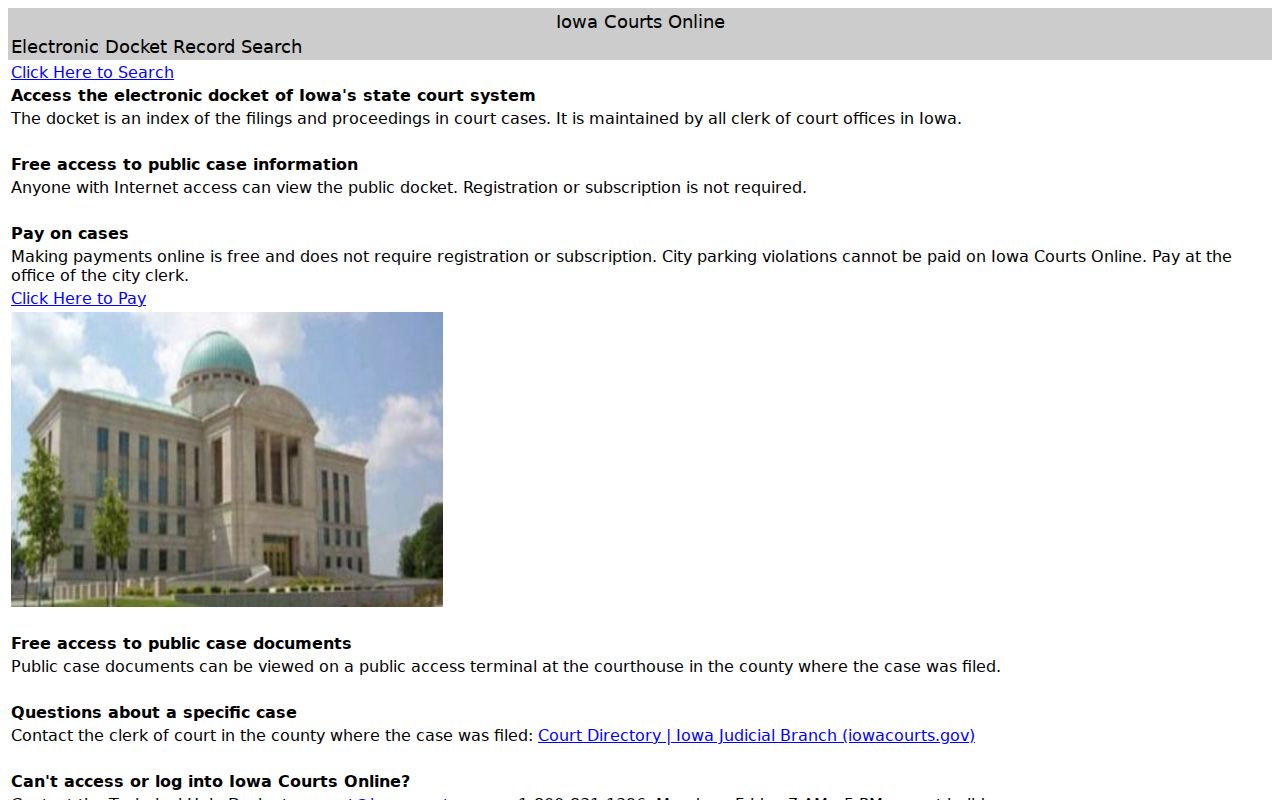
The county and case-type choices help separate a Muscatine County criminal docket from appellate, civil, or same-name results elsewhere in Iowa.
| Search control | Use | Practical note |
|---|---|---|
| Trial Court | Choose the trial search | Separates district cases from appellate records. |
| County | Select Muscatine | Reduces statewide name noise. |
| Case Number | Enter an exact docket ID | Best route when the number is known. |
| Last or Business Name | Start a party-name search | Confirm the result with other case facts. |
| First Name | Narrow a name result | Useful but not a unique identifier. |
| Case Type | Choose criminal where offered | Keeps unrelated case types out. |
How to Search Case Records
A careful search moves from the broad public docket to the clerk's source file. It also separates a filed allegation from a finding of guilt. Use these steps for a Muscatine County case, and note the retrieval date because new filings and dispositions can post after the first search.
- Open Iowa Courts Online and choose the trial-court search route.
- Select Muscatine County, then search by exact case number or party name.
- Narrow with first name and criminal case type, and compare filing dates and charges.
- Open the docket and read each charge, event, status, disposition, sentence, and document-availability entry.
- Ask the Muscatine clerk for inspection, copies, or a certified record when the public view is incomplete.
For court debt, the Judicial Branch has a separate payment search. The official Iowa court payment channel is shown in the next image.

A balance or payment entry is one part of the docket. It does not replace the judgment, sentence, or charge disposition.
Note: A docket description can be public even when the document image requires a clerk request or is restricted.
Muscatine County Court Document Gaps
No image beside a docket event does not mean the event never occurred. Iowa Courts Online can expose a filing description while the scanned document remains unavailable, fee-gated, or restricted. Older Muscatine County material may also require a courthouse terminal, counter visit, phone inquiry by case number, or mail and copy request. Give the clerk the case number, document title, event date, and preferred form of delivery.
The clerk can explain access and copying routes, but cannot give legal advice. Public terminals and the counter are also useful when a name search fails or an archived file has not been converted to an online view. Confirm current counter hours and direct contact details through the court directory before a visit. Court security, device, language-access, interpreter, and accommodation questions also belong with the Judicial Branch.
What the Case File Shows
A Muscatine County court case file follows the charge from filing through its final recorded outcome. The header identifies the docket, court, type, filing date, and status. Party and attorney fields show who appeared, while public charge rows identify the accusation, Iowa Code section, degree or class, count, and disposition. Protected identifiers are not part of a public copy.
| Case Header | Case number, Muscatine County, case type, filing date, and status. |
|---|---|
| Parties and Counsel | State, defendant display, attorneys, and judge where shown. |
| Charges Filed | Description, Iowa Code section, degree or class, count, and outcome. |
| Docket Events | Appearances, motions, scheduling orders, hearings, and filed orders. |
| Disposition and Judgment | Dismissal, acquittal, deferred judgment, conviction, or another recorded result. |
| Sentence and Money | Sentence terms, fines, surcharge, costs, restitution, and payment status where public. |
| Cross-References | Related appellate or linked cases when the system supplies them. |
Read the charge row together with its disposition. A filed count is an allegation. The final field may show a dismissal, acquittal, deferred judgment, or conviction, and those outcomes have very different legal effects.
Muscatine County Court Charge Labels
Iowa's labels help a reader gauge the filed level, but they do not decide the outcome. Trial information is a prosecutor-filed charging instrument often used for an indictable offense. An indictment is a grand-jury accusation. Either is a charge, not proof. Simple, serious, and aggravated misdemeanors, along with Class A through D felonies, all route through Iowa District Court in Muscatine County.
Iowa sentencing law supplies the context. The chapter 901 sentencing procedure source is reflected in the image below.
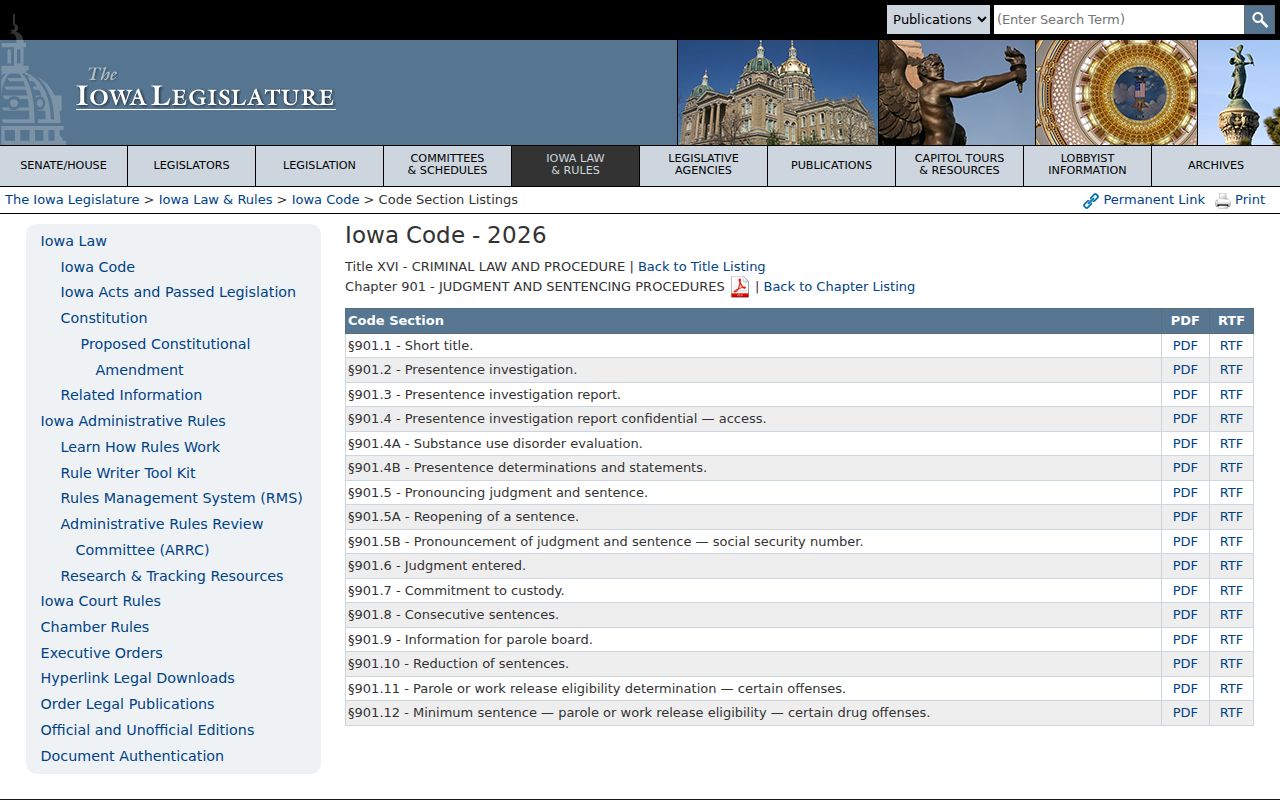
That chapter should be read with the charge-specific statute and the docket's actual judgment, since offense terms and special rules can control.
- Trial information
- An Iowa prosecutor-filed charging instrument for an indictable offense.
- Disposition
- The recorded outcome of a charge or case.
- Deferred judgment
- Judgment is held back while court-ordered terms are completed.
- Mittimus
- A court order directing custody or service of a sentence.
Stages of a Criminal Case
A Muscatine County criminal court case may begin with an arrest or summons. A prompt initial appearance addresses rights and release. The prosecutor may then file a complaint or trial information, or a grand jury may return an indictment. Arraignment records the plea. Discovery, motions, and scheduling follow before a negotiated plea or trial.
Case flow: Charges Filed → Arraignment → Pretrial → Plea or Trial → Disposition → Sentencing
Appeal or postconviction activity can add more events after judgment. The docket should be read as a timeline, not as a single status label. A warrant entry, financial posting, or hearing date may describe one step without answering the final outcome. For the arrest and booking trail that came first, the county's arrest history records provide the matching agency and custody channels.
Muscatine County Court Office Roles
The courthouse clerk and County Attorney sit near each other in Muscatine, but their record duties differ. The clerk holds the court file and directs inspection, copies, and certified-document requests. The County Attorney at 420 East Third Street files or prosecutes state charges, City of Muscatine violations, and county ordinances. It also handles victim services and collections, but it does not represent private people.
Muscatine Clerk of District Court
401 East Third Street
Muscatine, IA 52761
Use the Judicial Branch directory to verify the direct phone and current counter hours.
Muscatine County Attorney
420 East Third Street
Muscatine, IA 52761
563-263-0382
Weekdays, 8:00 a.m. to noon and 1:00 to 4:30 p.m.
A request for the filed case goes to the clerk. Questions about a sheriff report belong with the creating agency, while statewide fingerprint-backed history belongs with Iowa DCI.
Access & Restrictions
Iowa Code chapter 22 supports access to identifiable public records, but public status does not open every field. Juvenile court material is generally confidential. Victim-sensitive information, protected identifiers, sealed information, and some security or investigative material may be withheld or redacted. Online access can also be narrower than the clerk's public paper file.
A missing Muscatine County result may reflect spelling, the wrong county, timing, archive status, or a lawful restriction. Search again by case number if available, then ask the clerk about inspection or copies. If the issue is a statewide rap sheet that has not yet received the court disposition, compare the clerk's final order with a DCI self-review and use DCI's challenge route.
Muscatine County Sentencing Records
The judgment and sentence section may list confinement, probation, fines, surcharge, court costs, restitution, and other terms. Bond entries are different. Bond concerns release and appearance before final disposition; a fine is a penalty imposed through judgment. A court payment screen can show money due without explaining the full sentence, so compare it with the docket events and order.
Felony penalties come from Iowa Code chapter 902. Its official text appears in the image below.
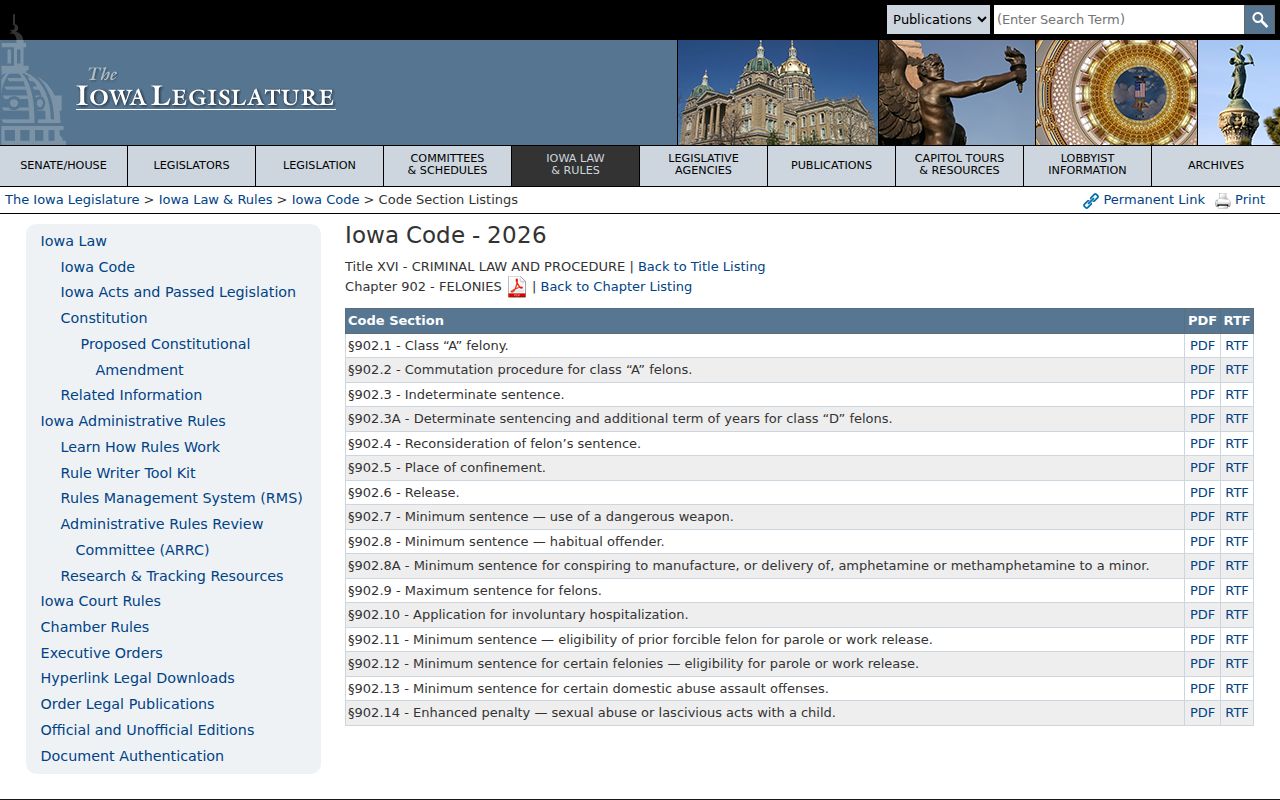
The filed offense and current statutory text control, so a class label alone should not be used to infer the exact term.
Misdemeanor sentencing is set out in Iowa Code chapter 903, shown here from the official legislature source.
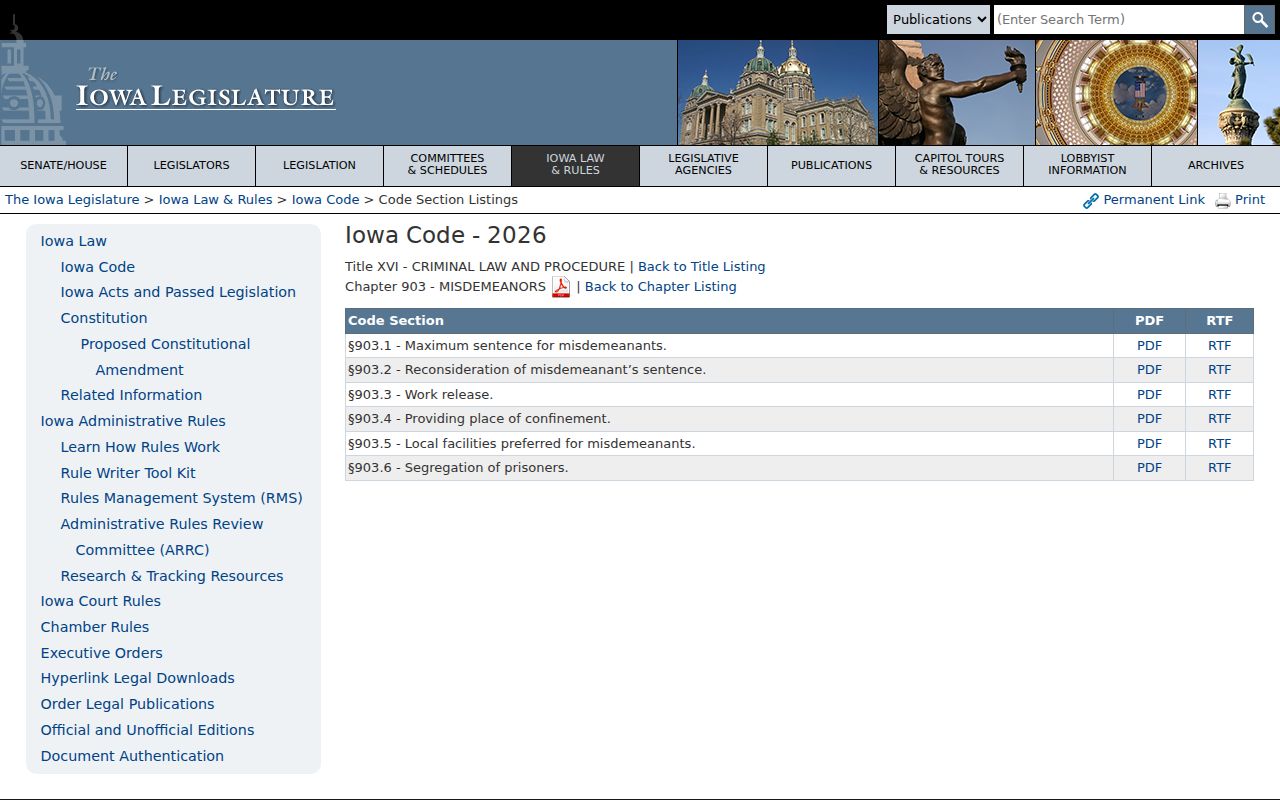
Simple, serious, and aggravated misdemeanors have distinct statutory ceilings, and offense-specific rules may alter the general framework.
Deferred judgment and expungement consequences appear in Iowa Code chapter 907. The official chapter is pictured below.
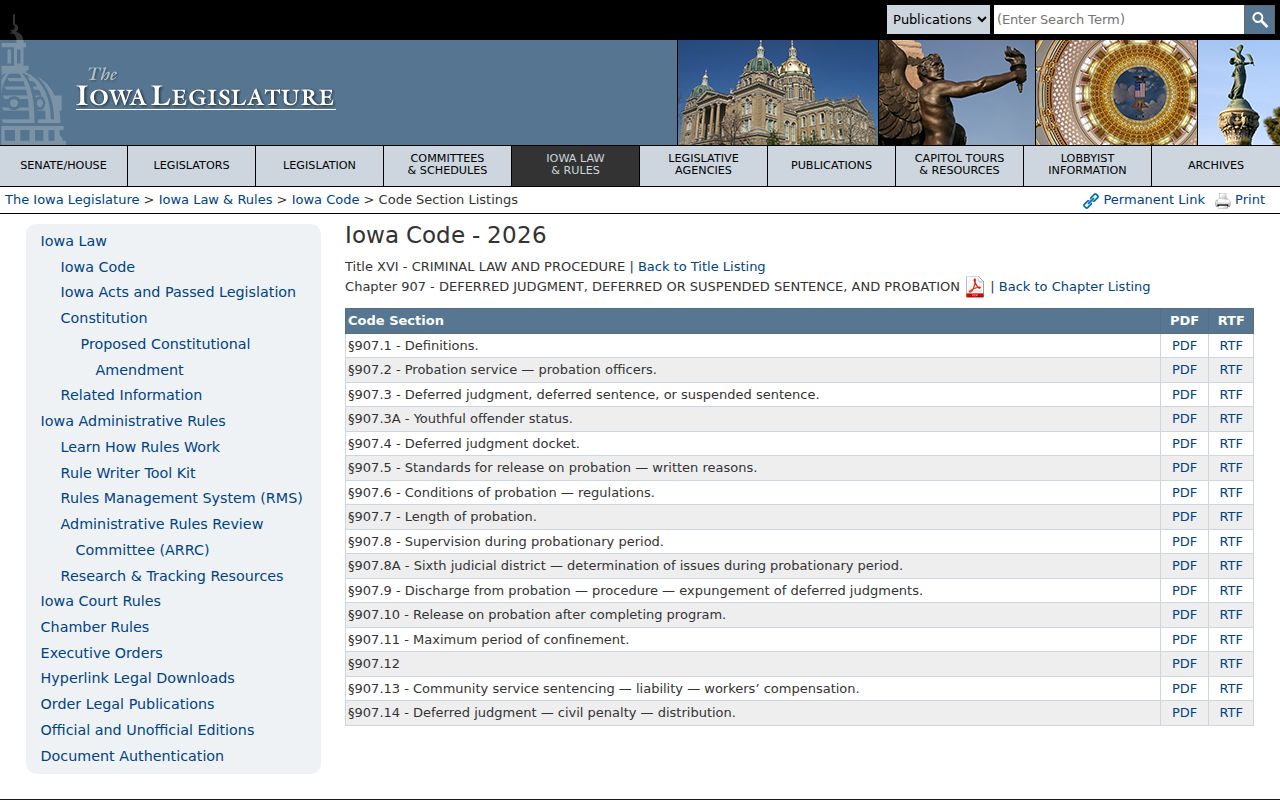
A successful discharge may be expunged at court yet remain at DCI as discharged nonconviction data, available under different release rules.