
How to Check Criminal History in Muscatine County
Start with the question, not a single search box. Present jail status belongs with the Muscatine County Sheriff's app or Jail Administration. Filed charges, hearings, and outcomes belong in Iowa Courts Online and the clerk's case file. A statewide fingerprint-backed history comes from the Iowa Department of Public Safety, Division of Criminal Investigation Records and Identification Unit. Iowa DOC Offender Search serves people in state prison or under state correctional supervision. Each channel answers a different part of a Muscatine County criminal record search.
The official Muscatine County government homepage identifies the county offices behind many of these records. Its layout also shows why the address in a page footer should not be treated as the location of every department.

Use the department's own location and contact block before visiting. A practical Muscatine County search follows this order:
- Decide whether the goal is current custody, a police narrative, a court outcome, or an Iowa rap sheet.
- Search Iowa Courts Online with the Muscatine County and criminal-case filters, then confirm the case number and dates.
- Check the Sheriff's app or call Jail Administration for current county custody, bond, or release status.
- Ask the arresting agency for the incident or arrest report when the narrative is needed.
- Submit both DCI request forms with the exact name and birth date for a releasable statewide history.
- Contact the clerk for archived material, document copies, or a docket entry that has no online image.
Four Muscatine County Record Counters
There is no universal Muscatine County criminal record counter. The courthouse at 401 East Third Street holds District Court case files. The jail at 400 Walnut Street creates booking and custody data. Sheriff's law-enforcement business is handled at 3600 Park Avenue West. DCI in Des Moines maintains the statewide criminal-history repository. The County Attorney prosecutes cases, but it is neither the clerk nor private counsel for a person seeking a record.
Clerk of District Court
401 East Third Street
Muscatine, IA 52761
Case files, dockets, and court copies
Muscatine County Jail
400 Walnut Street
Muscatine, IA 52761
563-262-4190
Sheriff's Office
3600 Park Avenue West
Muscatine, IA 52761
563-264-0188
County Attorney
420 East Third Street
Muscatine, IA 52761
563-263-0382
The county's Sheriff's Office page supplies the patrol-office hours, divisions, and app route.
That source is the sound place to confirm the office before making an in-person records request.
Official Iowa Background Checks
DCI offers the official Iowa name check. A member of the public may request a check on oneself or another person with a first name, last name, and exact date of birth. The fee is $15 for each last name searched. A signed release is not required to submit a request, but it changes the scope: without one, DCI excludes discharged deferred judgments and arrests more than 18 months old that still lack a final disposition.
The official Iowa criminal-history record check page provides online, mail, fax, email, and in-person channels.
DCI accepts no phone requests. Online work often takes one to three days as staffing allows, while DCI's general guidance gives a two-to-five-business-day range. Immediate in-person results are only for the subject who presents government photo identification.
| Official product | Cost | Main input | Coverage |
|---|---|---|---|
| Iowa DCI name check | $15 per last name | Name and exact date of birth | Releasable Iowa fingerprint-backed history |
| Iowa court docket search | Free public query | Name, case, and county filters | Filed Iowa court cases |
| FBI Identity History Summary | Current FBI fee | Subject request and fingerprints | The subject's FBI-maintained national summary |
| Local agency report | Not published countywide | Incident identifiers | The creating agency's report |
Muscatine County DCI Name Checks
A name is a retrieval key, not the foundation of an Iowa history. DCI says every Iowa criminal history begins with a fingerprint card. Exact identifying facts still matter because common names and spelling variants can return the wrong lead. Include the middle name, gender, or Social Security number only when it is useful and the official form is being handled securely.
| DCI field | Required | Use |
|---|---|---|
| First and last name | Yes | Exact subject name; each last name carries a separate fee |
| Date of birth | Yes | Primary match and common-name control |
| Middle name and gender | No | Extra match detail |
| Release authorization | No | Changes disclosure of specified nonconviction data |
| Requester contact | Yes | Delivery by the permitted return route |
| Request and billing forms | Yes | Both must be submitted or DCI will not process the request |
Cash, check, money order, Visa, MasterCard, Discover, or an applicable DCI account may be used through the channels DCI permits. For a dispute, a person may request a self-review and contact DCI; fingerprints may be needed to resolve identity. A county court search cannot replace that state review.
Types of Criminal Records
The words “criminal record” can refer to records made at different stages. Muscatine County police and sheriff personnel create incident and arrest reports. The jail adds intake, bond, and release facts. The clerk keeps filed charges, motions, orders, dispositions, and sentence entries. DCI assembles reported fingerprint-backed cycles, while Iowa DOC and the Board of Parole cover state custody and parole authority.
- Incident and arrest report: the creating agency's account of the event and probable-cause allegation.
- Booking record: the jail's local custody, charge-at-intake, bond, and release data.
- Court case file: the judicial record of filed counts, events, outcomes, and sentence.
- DCI history: releasable statewide arrest cycles and reported dispositions tied to fingerprints.
- Warrant or supervision record: a court, law-enforcement, DOC, district-corrections, or parole record, depending on status.
The official Muscatine County Jail Division page describes the county custody channel and jail services.
It does not function as the archive for every city police narrative or as a substitute for a court disposition.
Muscatine County Booking and Court Flow
A local record changes shape as a case moves. An officer first creates incident and arrest material. The jail makes a separate booking entry after intake. Fingerprints and identifying data can establish an arrest cycle at DCI. The Muscatine County Attorney then decides what state or city charge to file, and Iowa District Court records each judicial event. Courts and justice agencies report the final disposition back to DCI, but the updates may not arrive at the same time.
Record flow: Arrest report › Muscatine County booking › prosecutor filing › Iowa District Court disposition › DCI update.
The Muscatine County Attorney page states the office's prosecution role and service limits.

The prosecutor is not the clerk and cannot give private legal advice. If a Sheriff's app entry and a court result differ, compare their dates and purposes before assuming either is wrong.
What a Muscatine County Criminal Record Shows
A Muscatine County court file can show the case number, court, filing date, case status, parties, charge and Iowa Code section, attorney, judge, hearings, docket events, disposition, sentence, fines, court costs, restitution, and public warrant or appellate links. A DCI response is organized around identification and fingerprint-backed arrest cycles. The jail record focuses on custody. Public output omits fields Iowa law protects.
| Name and identifiers | Name, aliases, date of birth, and repository identifiers where releasable. |
|---|---|
| Arrest and booking data | Agency, intake event, alleged charge, bond, custody, and release information. |
| Charges and statutes | Filed count, Iowa Code citation, class, and amendments shown by the court. |
| Disposition | Dismissal, acquittal, deferred judgment, conviction, or another recorded outcome. |
| Sentence | Custody, probation, fine, costs, restitution, and related court terms. |
| Supervision | Public state custody, probation, parole, or release details in the proper system. |
- Disposition
- The recorded outcome of a charge or case.
- Deferred judgment
- An Iowa process that postpones judgment while conditions are completed.
- Trial information
- A prosecutor-filed charging instrument used for indictable offenses in Iowa.
- Mittimus
- A court order directing custody or service of a sentence.
Muscatine County Jail or Iowa DOC
The Muscatine County Jail is the right channel for a recent local arrest or a person held before trial. The Sheriff's official FAQ sends questions about why someone is held, what bond means, and when release may occur to the free Sheriff's app. The website does not display a conventional public jail roster form. When the app does not settle present status, call Jail Administration at 563-262-4190.
People serving state sentences or under state correctional supervision belong in Iowa DOC Offender Search.
That locator is not a county booking log. During business hours, bond is posted with the clerk. After hours, the jail's south lobby handles bond. The jail states that bond requires cash or a bonding company and does not accept personal checks or credit cards.
Note: A move from county custody to state custody can create a short gap between two systems that serve different populations.
Public Access Laws
Iowa's open-records rules begin with the office that keeps the existing record. A focused request should identify the record type, event date and place, creating agency, report or case number when known, and preferred copy format. Public access does not open every field. Juvenile material, victim-sensitive facts, confidential intelligence, security information, medical details, and private identifiers may be withheld or redacted.
Key Iowa laws:
Iowa Code chapter 22 gives access to public records and defines confidential categories.
Iowa Code sections 692.2 and 692.18 govern criminal-history dissemination and public-record status.
Iowa Code section 692.5 gives a person access and challenge rights for criminal-history data.
Iowa Code section 232.147 makes most juvenile court records confidential.
Iowa Code chapter 907 addresses deferred judgments and related expungement effects.
The official Census QuickFacts profile adds useful scale to Muscatine County record searches.
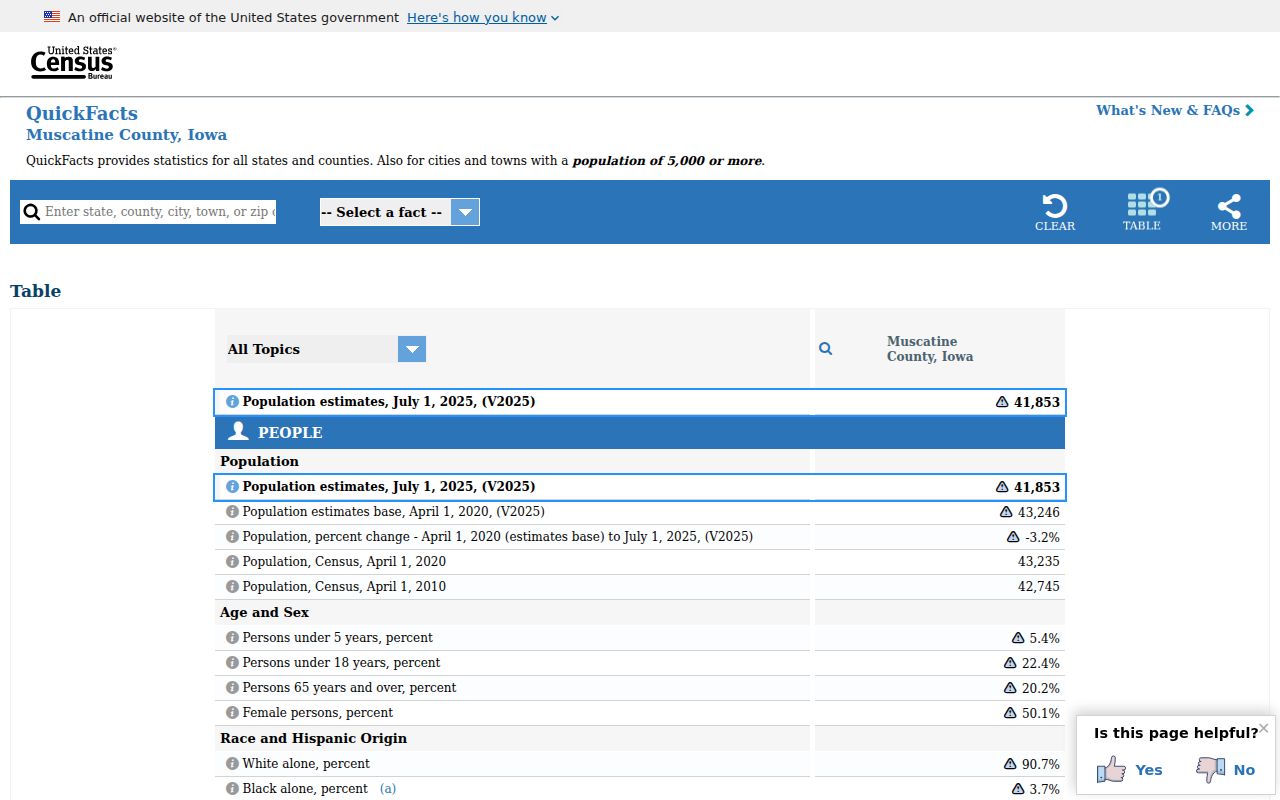
The Census profile supplies county scale, while chapter 22 controls the record request itself. Muscatine County had an estimated 41,853 residents on July 1, 2025, so a full name and exact date can matter in a common-name search.
Muscatine County Warrant Record Fallbacks
No official public Muscatine County web warrant search was found in the reviewed sources. Do not assume the Sheriff's app supplies one. Start with the related Iowa Courts Online docket, then ask the clerk about public case information. The issuing or arresting agency may hold releasable warrant facts, and a focused chapter 22 request is another route. Some unexecuted, sealed, search, or juvenile warrants will not be open.
Warrant data may show the name, case number, issuing court and date, underlying charge, warrant type, and bond. Anyone resolving a possible warrant should verify the case and court, ask about appearance or bond instructions, and consider legal advice. After the court recalls or satisfies the warrant, keep the record of that action and allow time for connected systems to update.
Sealed, Expunged & Restricted
Iowa does not have one process that erases all arrests or convictions. Eligibility turns on the outcome, offense, and controlling statute. A person reviewing a Muscatine County record should obtain the court docket and a DCI self-review, identify the exact disposition, locate the right Iowa expungement provision, and follow the Iowa District Court filing route directed by the clerk. Current forms and fees should be confirmed before filing.
A successfully discharged deferred judgment can be expunged at the court level under chapter 907, yet DCI says it remains in the repository marked “discharged.” DCI treats it as nonconviction data and releases it only with signed authorization. DCI also withholds an arrest more than 18 months old with no reported final disposition when no release is supplied. Neither rule proves the source record was destroyed.
Juvenile court files are generally confidential, and ordinary public DCI results do not include confidential juvenile records. Protected identifiers and victim or minor information can also be removed from copies.
Muscatine County Diversion Record Trail
Muscatine County's Jail Diversion Program connects a court sentence with Sheriff's administration. Eligible people serving up to 30 days may perform supervised public work and use electronic home monitoring under a sentencing order with the required mittimus language. Crimes against persons and prior felony convictions disqualify a person. The participant must contact the program within ten days after sentencing, and a schedule change requested with less than 48 hours' notice will not be considered.
The official Alternative Sentencing page describes that county-specific route.
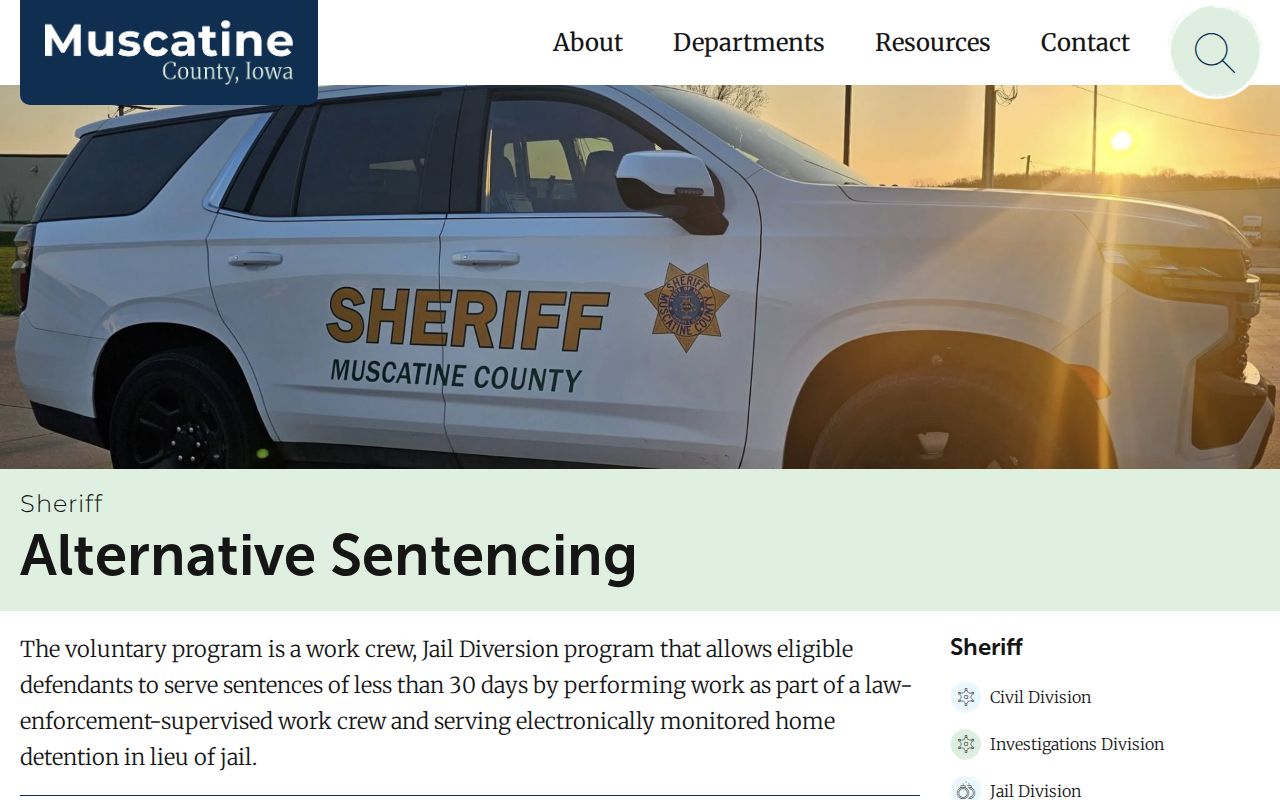
The program is distinct from probation, which runs through the Seventh Judicial District Department of Correctional Services. Its record trail can include the sentence and mittimus in the court file, followed by jail eligibility screening and program administration.
Criminal Records by City in Muscatine County
City police create their own incident and arrest reports, but criminal cases use Iowa District Court rather than separate municipal criminal databases. People arrested in Muscatine, West Liberty, or Wilton route to the county custody system identified by official sources. Each local guide starts with the proper police contact, then follows the record to the Muscatine County Jail, Iowa Courts Online, and DCI when a statewide history is needed.
Muscatine Criminal History
County seat with a dedicated Police Records Division and city open-record policy.
West Liberty Criminal History
Police reports begin with the city; bookings and cases move to county systems.
Wilton Criminal History
Boundary-area incidents require care when selecting the county of court filing.
Muscatine County Records Across Time
The county's jail history makes location checks especially important. The first jail was ordered in 1839. The surviving Old Jail was built in 1857 across Fourth Street from the courthouse and now forms part of a National Register setting. A 1907 replacement cost $15,000, plus $6,000 for its steel cage and fittings. Voters later approved an $8.5 million bond in 1990, and the current jail was dedicated in 1996.
Historic buildings are not today's record counters. The modern jail at 400 Walnut Street has a rated capacity of 255 and handles present custody work. The operational Sheriff's office is on Park Avenue West. The clerk remains at the courthouse. These separate points keep a Muscatine County criminal history search from being sent to the attractive but wrong landmark.
The official Iowa Sex Offender Registry adds a purpose-specific statewide layer to the local record map.
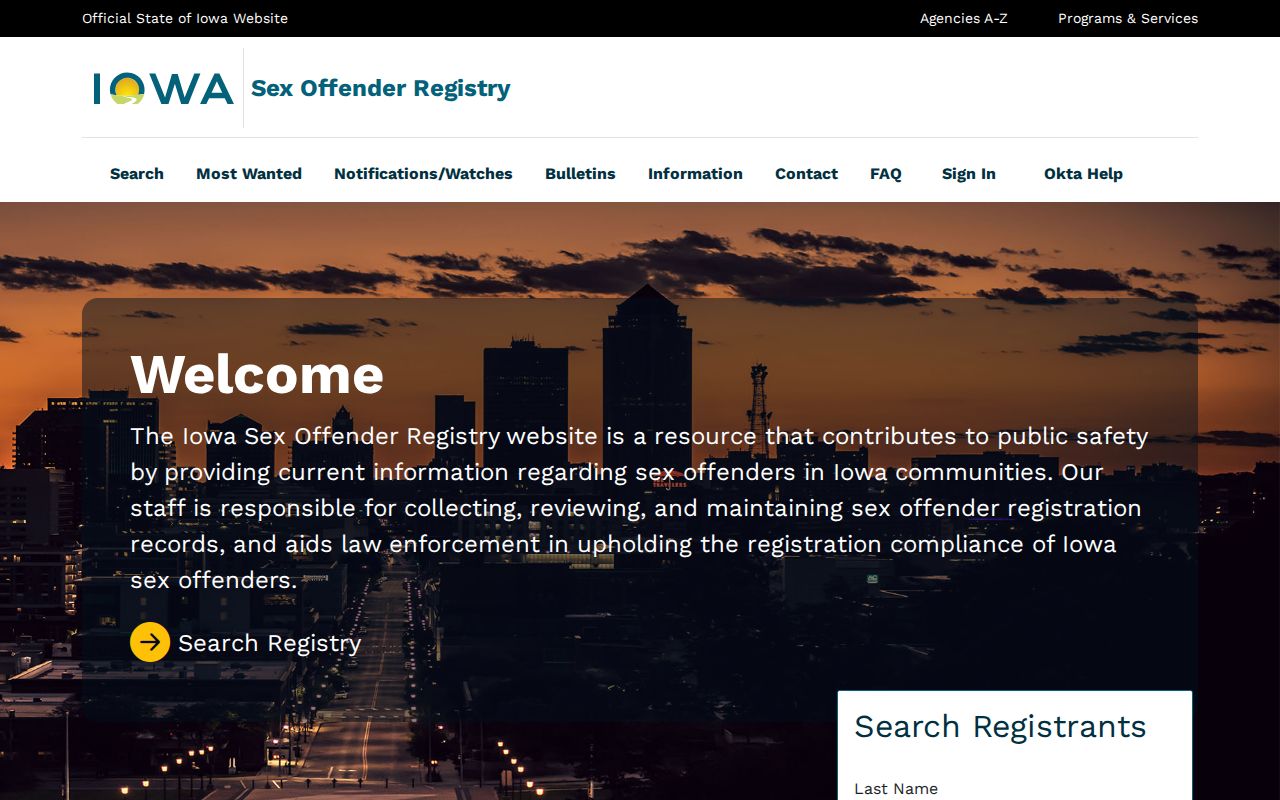
Registry information serves public safety and carries its own lawful-use warning. It is not a substitute for the court case, booking entry, or DCI rap sheet behind a person's broader history.